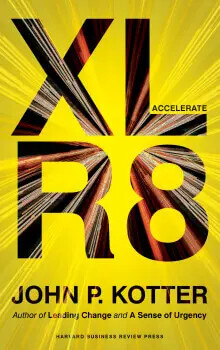
In Accelerate, the world’s preeminent expert on leadership and change provides a fresh, persuasive take on achieving strategic agility in the face of constant turbulence. Based on his award-winning article in Harvard Business Review, John P. Kotter urges organisations to create a dual operating system that combines the still-crucial corporate hierarchy with a second, more agile, network-like structure. This, he says, is the key to succeeding in the face of today’s fast moving, volatile environment. This book is for leaders and professionals ready to embrace the bold change necessary to succeed today, no matter your business or industry
Kotter’s rightly famous for his books on change, but I don’t think this one gets enough love.
For me, it’s the best articulation of how to create organisational change using principles aligned to agile, recognising that organisations are naturally complex, and that change needs to come from the people in the organisation rather than being applied to them.
I’m also struck by the counterpoints to Corporate Rebels’ thinking, who are very clear that it’s all about the network as a single operating model. Whereas Kotter’s primary thesis is that you need both networks and hierarchies, which has always made sense, but I’m now wondering whether that’s entirely true. Can organisations survive without managers and a hierarchy? Corporate Rebels would say absolutely, and have the evidence to prove it.
But what is nailed on is that there’s a need for delivering both change (including innovation) and run (and for operating in different Cynefin environments), and that different models (ways of working and organising) are needed for each. I’ve been reflecting on this in the context of some recent clients. Their teams (including the leadership team) had a mix of modes. There was stuff that just needed doing every day/week/month, and it made sense for them to give that to an individual (with some backup redundancy) as the most efficient way of doing it. But there was also more nebulous change/new stuff, that it made more sense for them to swarm on and work on across team boundaries. Meaning they outgrew Scrum and SAFe very quickly, as it only answered one half of their needs.
Which also means that the Accelerate/network model isn’t a model for delivering one-off change, but a model for how you embed continuous change in your organisation as an equal partner to running your existing business.
I summary, a highly recommended book, extremely well written, with some fabulous storytelling that brings its ideas to life.
1 Like